

Options Pricing Suite
Explore option pricing, Greeks, and strategy payoff charts.
Scan with your phone's camera to get the app.
Try a strategy
Pick a strategy, then drag the price. The line shows the profit or loss at expiry.
Price at expiry112.00
Profit4.00
- Cost
- 8.00
- Break-even
- 92.00 and 108.00
- Max profit
- Unlimited
- Max loss
- 8.00
Example prices. In the app, each leg is priced from the inputs you choose.
-
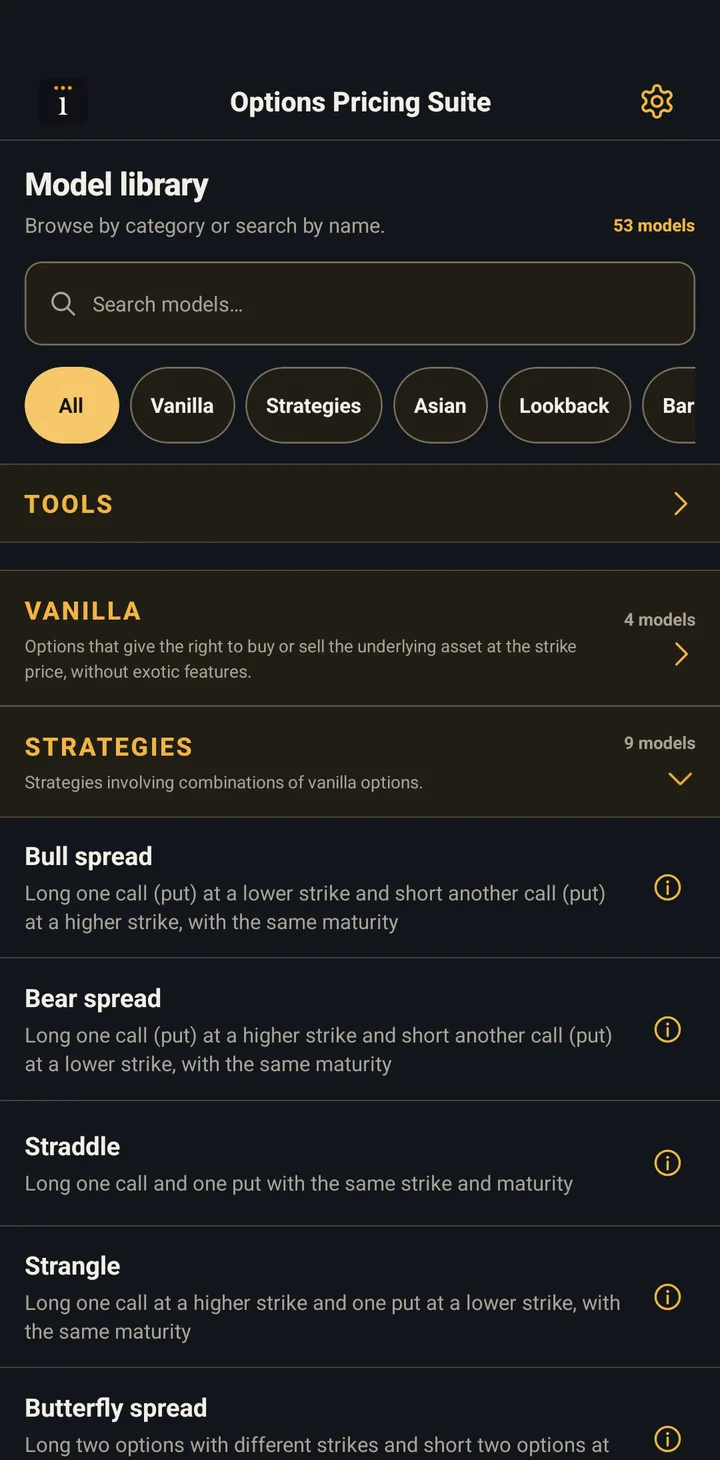
Browse by category or search by name, from a plain European call to exotic options.
-
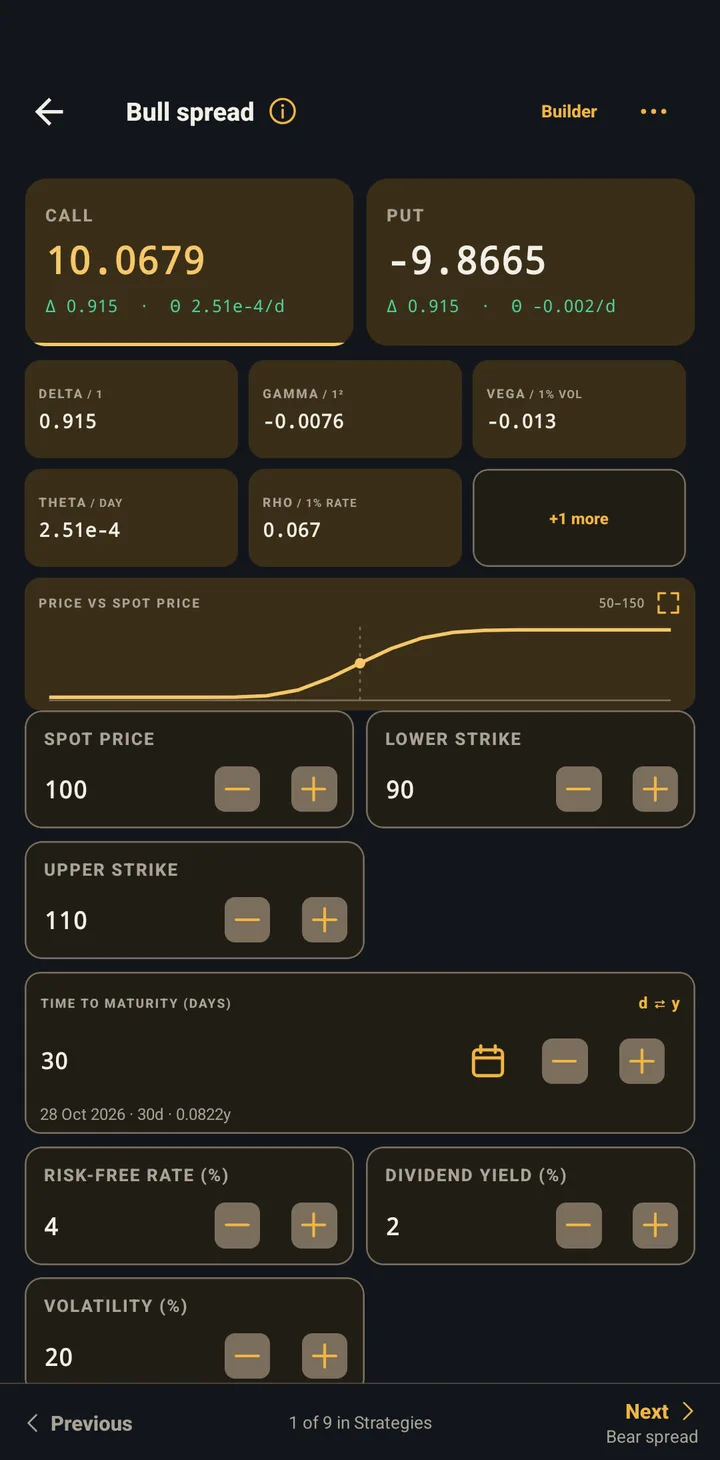
See each model's price and Greeks, and chart how they move with spot and time.
-
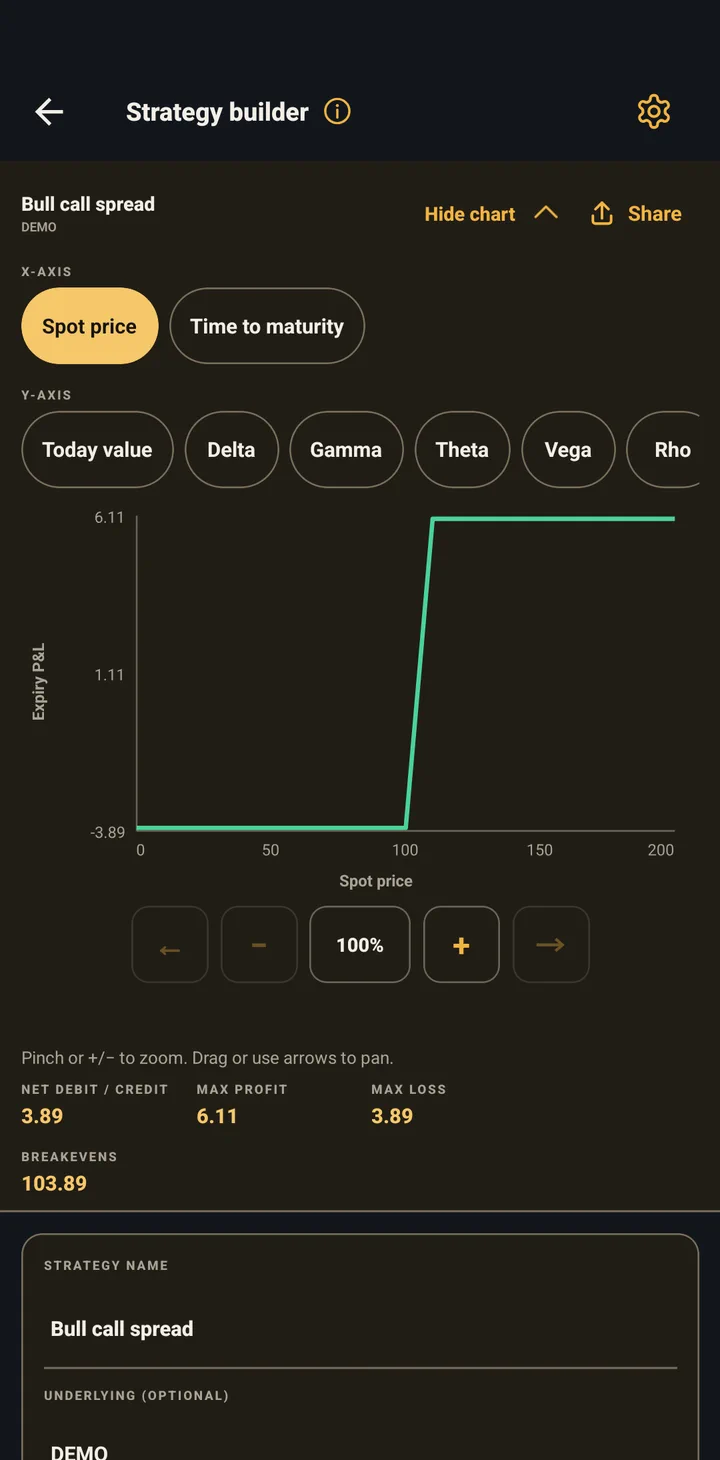
Combine calls and puts into a strategy, then see its payoff, Greeks, break-evens, and maximum profit or loss.
-
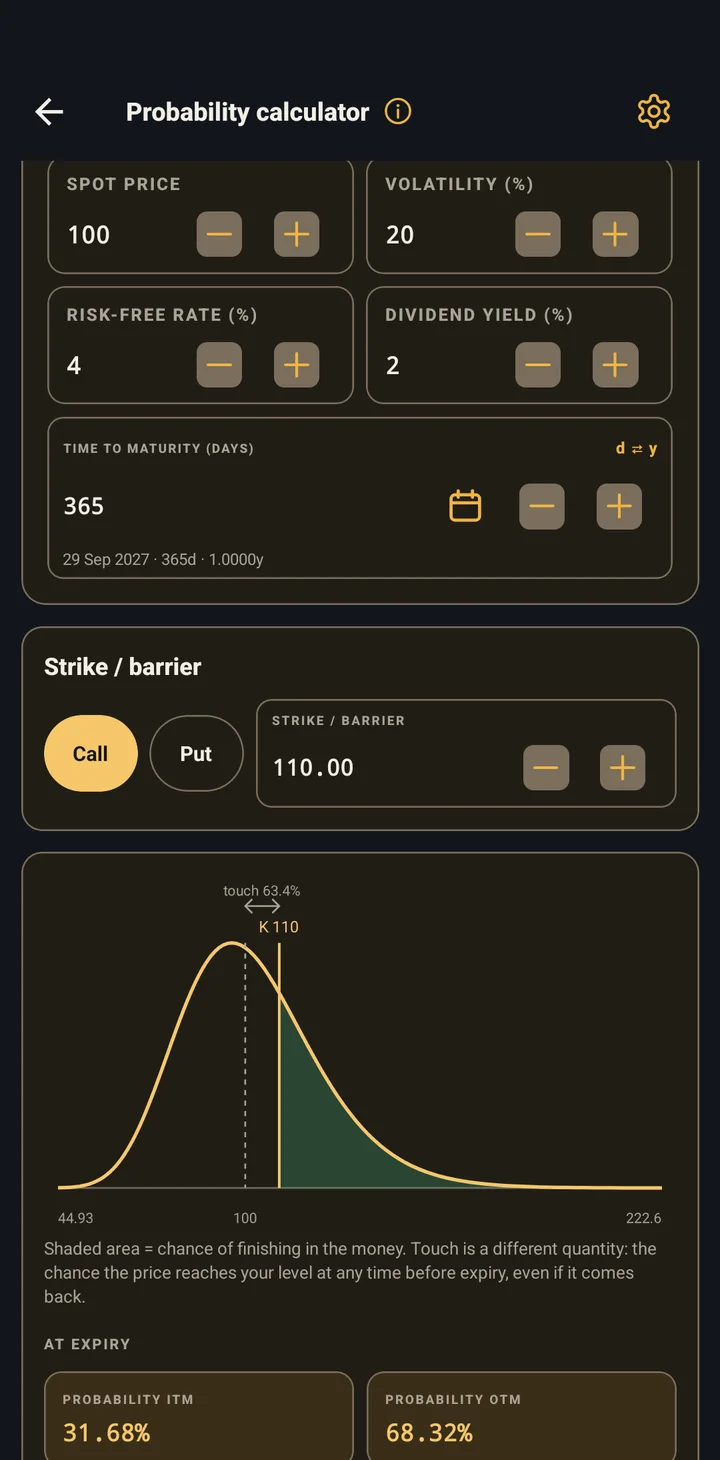
Calculate probability of an option finishing in or out of the money.
Features
-
Strategy presets
Start from a vertical spread, straddle, strangle, butterfly, or iron condor, then adjust each leg's strike, quantity and direction.
-
Expected move
See the price range a straddle implies, compare it with a level you care about, and chart the range through time.
-
Portfolio Greeks
See the combined Greeks of the strategies you save. New to them? Read the Greeks explained.
-
Implied volatility
Enter an option's price and solve for implied volatility. See what implied volatility means.
53 Models
Vanilla 4 models European option, American option, Stochastic volatility option, Implied volatility
Options that give the right to buy or sell the underlying asset at the strike price, without exotic features.
- European option
Options may be exercised only at expiration.
- American option
Options may be exercised at any time before or at expiration.
- Stochastic volatility option
European options, with volatility following a random process.
- Implied volatility
Given the option price, find the corresponding volatility.
Strategies 9 models Bull spread, Bear spread, Straddle, Strangle, Butterfly spread, Condor spread, Strip/strap, Front spread, Back spread
Strategies involving combinations of vanilla options.
- Bull spread
Long one call (put) at a lower strike and short another call (put) at a higher strike, with the same maturity.
Used when anticipating price increases.
- Bear spread
Long one call (put) at a higher strike and short another call (put) at a lower strike, with the same maturity.
Used when anticipating price decreases.
- Straddle
Long one call and one put with the same strike and maturity.
Used when anticipating large price movement in either direction.
- Strangle
Long one call at a higher strike and one put at a lower strike, with the same maturity.
Used when anticipating large price movement (greater than when using a straddle) in either direction.
- Butterfly spread
Long two options with different strikes and short two options at the midpoint strike, with the same maturity.
Used when anticipating only minimal price movement in either direction.
- Condor spread
Long two options with different strikes and short two options at strikes in between, with the same maturity.
Used when anticipating only minimal price movement in either direction, with more flexibility than a butterfly spread.
- Strip/strap
Long one call (put) and two puts (calls), with the same strike and maturity.
Used when anticipating large price movement in either direction, with a decrease (strip) or an increase (strap) more likely.
- Front spread
Long one call at a lower strike and short two calls at a higher strike, or short two puts at a lower strike and long one put at a higher strike, with the same maturity.
- Back spread
Short one call at a lower strike and long two calls at a higher strike, or long two puts at a lower strike and short one put at a higher strike, with the same maturity.
Asian 2 models Arithmetic Asian option, Geometric Asian option
Option payoff depends on the average underlying asset price during the life of the option. Strike is fixed.
- Arithmetic Asian option
Averaging is arithmetic: (x1+x2+x3+…+xn)/n.
- Geometric Asian option
Averaging is geometric: (x1*x2*x3*…*xn)^(1/n)
Lookback 2 models Floating-strike lookback option, Fixed-strike lookback option
Option payoff depends on the maximum or minimum underlying asset price during the life of the option.
- Floating-strike lookback option
Call holder can buy the underlying at the lowest price observed during the life of the option. Payoff at expiration is
(Spot - Min spot).Put holder can sell the underlying at the highest price observed during the life of the option. Payoff at expiration is
(Max spot - Spot).- Fixed-strike lookback option
Strike is fixed, but option exercise is not at the market price.
Call holder can exercise at the highest underlying price observed during the life of the option. Payoff at expiration is
max(Max spot - Strike,0).Put holder can exercise at the lowest underlying price observed during the life of the option. Payoff at expiration is
max(Strike - Min spot,0).
Barrier 2 models Single barrier option, Double barrier option
Option payoff depends on whether the underlying asset price hits the barrier price level.
- Single barrier option
Option activates or expires if the underlying price crosses the specified barrier level.
- Double barrier option
Option activates or expires if the underlying price drops below the lower barrier or exceeds the upper barrier.
May be inaccurate when the strike is outside of the barrier range.
Binary 3 models Cash-or-nothing option, Asset-or-nothing option, Gap option
Option payoff is a specified amount if it expires in the money, or nothing if it expires out of the money.
- Cash-or-nothing option
If in the money, option pays a fixed cash amount at expiration.
Calls pay the cash payment if
(Spot > Strike), otherwise nothing.Puts pay the cash payment if
(Spot < Strike), otherwise nothing.- Asset-or-nothing option
If in the money, option pays the value of the underlying asset at expiration.
Calls pay the value of the asset if
(Spot > Strike), otherwise nothing.Puts pay the value of the asset if
(Spot < Strike), otherwise nothing.- Gap option
European option with two strikes. The stated strike determines whether a payoff occurs, and the payoff strike determines the amount of the payoff. Payoff may be negative.
Calls pay
(Spot - Payoff strike) if
(Spot > Stated strike), otherwise nothing.Puts pay
(Payoff strike - Spot) if
(Spot < Stated strike), otherwise nothing.
Binary barrier 7 models Cash-or-nothing payoff, Asset-or-nothing payoff, Cash-or-nothing option, Asset-or-nothing option, Double barrier binary, Asymmetric barrier option, Supershare
Options that combine the features of barrier options and binary options.
- Cash-or-nothing payoff
Option pays out a fixed cash amount if the barrier condition is met. Payment can be made when the barrier event occurs or at maturity of the option.
- Asset-or-nothing payoff
Option pays out the value of the underlying asset if the barrier condition is met. Payment can be made when the barrier event occurs or at maturity of the option.
- Cash-or-nothing option
Option pays out a fixed cash amount if the barrier and strike conditions are met. Payment is made at maturity of the option.
- Asset-or-nothing option
Option pays out the value of the underlying asset if the barrier and strike conditions are met. Payment is made at maturity of the option.
- Double barrier binary
Option pays out a fixed cash amount depending on whether the spot price remains in or exits the barrier range. Payment is made at maturity of the option.
- Asymmetric barrier option
Option pays out a fixed cash amount immediately if one barrier is hit, or expires if the other barrier is hit.
- Supershare
If the spot price at maturity is within the barrier range, the payment made is the ratio
(Spot / Lower barrier), otherwise nothing.
Compound 2 models Option on a call, Option on a put
European options whose underlying asset is another European option.
- Option on a call
European option on a European call option.
- Option on a put
European option on a European put option.
Power/log 6 models Power contract, Power option, Powered option, Log contract, Log contract (ratio), Log option
Option payoff depends on a power or logarithm of the spot and/or strike price.
- Power contract
Payoff at maturity is (Spot / Strike)^Power.
- Power option
Payoff at maturity depends on (Spot)^Power and can be capped.
- Powered option
Payoff at maturity depends on a power of the difference of the spot price and strike price.
- Log contract
Payoff at maturity is ln(Spot).
- Log contract (ratio)
Payoff at maturity is ln(Spot / Strike). Payoff may be negative.
- Log option
Payoff at maturity is max[ln(Spot/Strike),0].
Other exotics 2 models Chooser option, Accrual option
Miscellaneous exotic options on a single underlying asset.
- Chooser option
At the maturity of the option (the choice time), the holder can choose to receive a call option or a put option, each with a pre-specified strike and future maturity.
Payoff at the choice time is
max(Call price,Put price).- Accrual option
During the life of the option, the holder accrues a cash amount for each day the spot price is above or below the strike price. The payment of these accruals is made at maturity.
Two asset exotics 8 models Two-asset barrier option, Two-asset binary option, Min/max option, Spread option, Exchange option, Correlation option, Product option, Quotient option
Exotic options that depend on two underlying assets.
- Two-asset barrier option
Barrier option for which the price of asset 2 is linked to barrier hits, while the price of asset 1 is compared with the strike to determine the payoff.
- Two-asset binary option
Cash-or-nothing option whose payoff depends on the prices and strikes of the two assets.
- Min/max option
Option payoff at expiration depends on the lower or higher of the two asset prices.
- Spread option
Option payoff at expiration depends on the difference between the prices of asset 1 and asset 2.
- Exchange option
At expiration, the option holder can exchange asset 2 for asset 1.
Payoff at maturity is
max(Quantity 1*Spot 1 - Quantity 2*Spot 2,0).- Correlation option
At expiration, the spot/strike relationship for asset 1 determines the moneyness, while the spot/strike relationship for asset 2 determines the payoff amount.
- Product option
Option payoff at expiration depends on the product of the prices of asset 1 and asset 2.
- Quotient option
Option payoff at expiration depends on the ratio of the prices of asset 1 and asset 2.
Currency-translated 3 models Quanto option, Foreign equity option, Equity-linked FX option
Options involving foreign currencies.
- Quanto option
Option price is in the domestic currency, while the underlying price and strike price are in the foreign currency.
- Foreign equity option
Option price and strike price are in the domestic currency, while the underlying price is in the foreign currency.
- Equity-linked FX option
Option on the exchange rate, linked to the forward price of a foreign equity or equity index.
Interest rate 3 models Bond option, Caplet / floorlet, Swaption
Options involving interest rate dependency.
- Bond option
European option on a zero coupon bond, using a Vasicek framework.
- Caplet / floorlet
European option on the forward interest rate.
- Swaption
Gives the right to enter into the underlying interest rate swap.
-
No account needed
Open the app and start.
-
Free
Every model and every tool is included.
-
Kept on your device
Your saved strategies and settings are stored on your device. See the privacy policy.
-
For learning, not advice
No live market data, no trading, and no investment advice.